
On starting all over again
It’s hard to change our own habits, so it's helpful when something changes them for us

I love the beginning of January. The fresh start – even though it’s an arbitrary one – prompts me to take stock of things, and usually gives me a much stronger feeling of clarity about my priorities than other times of year.
As I’ve mellowed into my thirties, my New Year’s resolutions have reduced to a short list of intentions and focuses for the year, in place of the slightly deranged and doomed-to-at-least-partial-failure lists of S.M.A.R.T. goals from my would-be-over-achiever twenties.
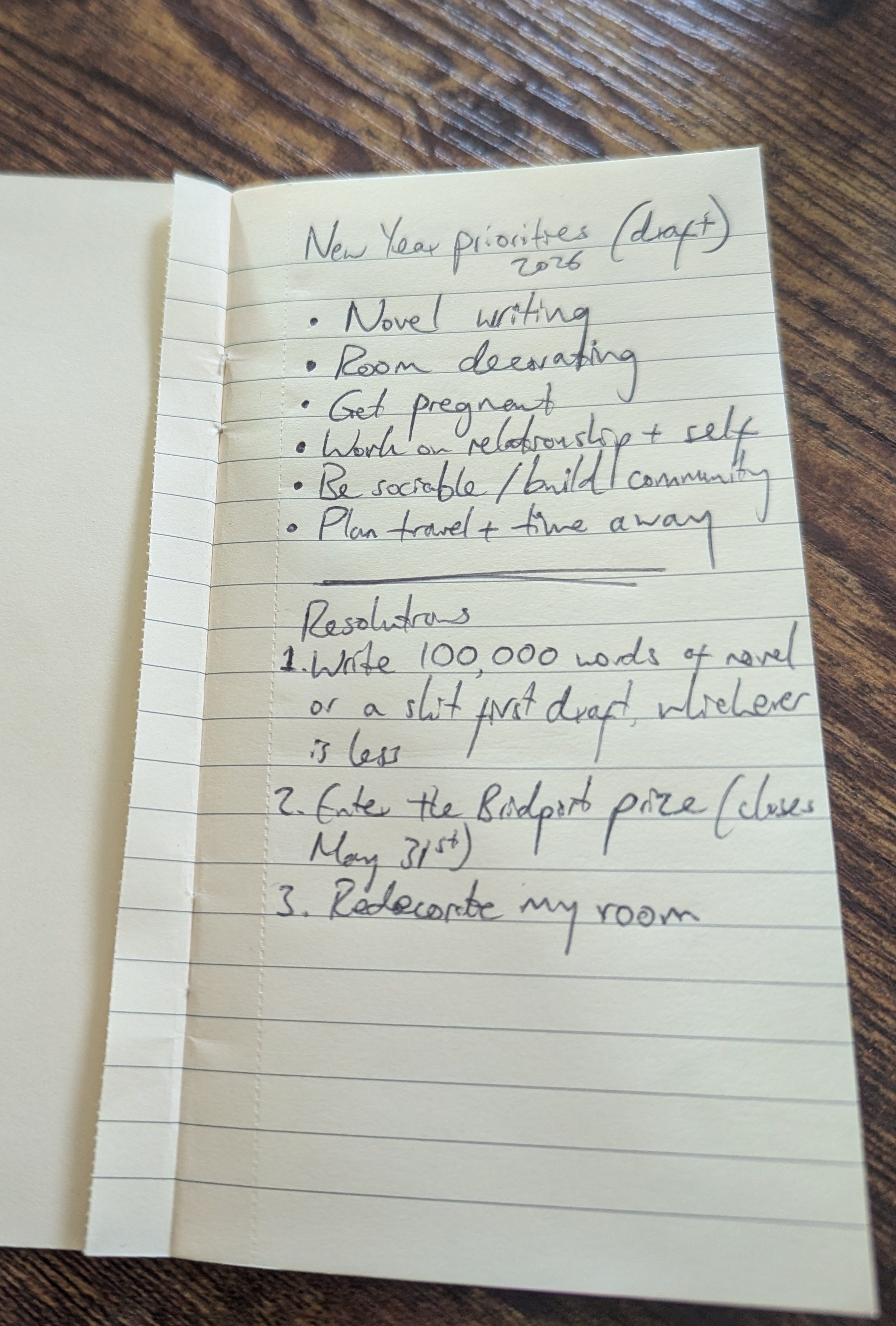
Still, a fresh start is a lovely thing. Unfortunately, I think this is partly because it gives us hope that we will suddenly be different from how we are now – more capable, more resilient, more focused and more energetic than the self we’ve been before. I’ve believed over and over again that habits which have eluded me for months or even years will suddenly be permanently achievable, just by pressing a magical reset button.
But as my twenties demonstrated, conjuring significant change through sheer force of will rarely works. For me, it’s been the project of many years to stop fighting everything quite so hard and shift towards more gradual and realistic changes. It’s possible to battle a headwind for a while, but it takes a hell of a lot of effort and generally, we mostly revert to how we were before.
When it comes to writing, I have all sorts of unhelpful habits that I’m trying to gradually shift. I continue to let the perfect be the enemy of the good – so if I don’t write consistently throughout the week (which I literally never do), or make the progress I think I should have made in a given time period (which I also literally never do), then at some point I tend to go into a despondent lull and not do anything for a bit. And I still occasionally look at something I’ve written, see that it’s not working and spiral into an inner-critic-fuelled hate cycle along the lines of ‘well this is all just shit and I’m a terrible writer and what’s even the point of doing this anyway?’1
But when I’m actually bedded down in writing something, it’s editing that’s my biggest issue. I still continually grapple with an inability to throw writing away, and I’m great at tinkering and tweaking for hours but not at making big, bold, drastic edits. I stay paralysed by the thought of how much time and effort I put in to create the bits that now need cutting, topped with a big dollop of scarcity mindset: ‘but what if I make it worse and then really need that bit but I don’t have it anymore?’
When I do make big edits, it’s always, without exception, by creating a new document, leaving the old one as it is and editing the fresh version. This is kind of okay when I’m just cutting out sections, but if what the piece actually needs is far more restructuring then it’s hard to not still be influenced by the bones of an old version.
What if, say on a novel, you really do need to start all over again? Perhaps the story needs to be structured differently? You chose the first-person voice but now it feels like it should be third-person? The dramatic tension would be better if the narrator was a different character? That’s a full rewrite – it means changing every single sentence. I know I’d really struggle to be brave and make that choice.

Recently, however, I’ve been thinking about what happens if the choice element is taken away. I’ve encountered a slightly more drastic and externally enforced push to start all over again. And – at the risk of trying to conjure up big changes all at once – perhaps it might be a handy shock to the system.
Back in November, I had the last session of a novel writing course, where the tutor was extolling the virtues of reworking writing. She told a story about Chimamanda Ngozi Adichie having to start Purple Hibiscus from scratch when her handbag – containing the handwritten manuscript – was stolen. Adichie later said that it was the best thing that could have happened precisely because it forced her to start again. Having already done so much of the work and the thinking, she could leave behind all the crap bogging her down and ended up with a much better novel than if she’d kept the original draft.
It was a powerful story for a room of novelists. And it also revealed to me that I was harbouring a pernicious double-standard: a secret belief that my novel should basically all just flow out in the correct order and with all the main elements in place. Oh editing, sure. Change a few words, take some adverbs out, fix the typos. A few tweaks here and there.
My rational brain knows this isn’t how it works, but I think I’m not the only writer who believes this deep down. As well as the collective shudder that went through the room at Adichie’s story, I wasn’t the only one wincing when our tutor told us that she rewrote her entire novel in response to her agent’s feedback. And more impressively, she said – breezily and believably – that she didn’t mind at all. Like Adiche, she could see that in the end it was a better novel for it.
It was a very strong challenge to my desire to keep everything I write. And the strength of the aversion I felt at the idea of losing a whole draft, or even completely changing a draft, made it inescapable: deep down I didn’t really want to countenance rewriting. Awkward.
Then the class ended, and I took this new-found and pretty uncomfortable insight with me to a coffee shop – where, in an extraordinary moment of coincidence, my bag was promptly stolen for the first time in my life.2
…No, I didn’t lose the first draft of my novel. My laptop was gone, but as everything on it lives in nebulous cyberspace my monstrous first draft still lives. What I did lose, and what was hardest to lose despite being the least financially valuable, was my notebook.
It had all my notes from the course, the feedback people had given me on my extracts, weeks and weeks of Morning Pages, and extensive notes on one of my characters as I tried to get under her skin. It was the same notebook that starred in my previous post on The sheer fucking untrammelled joy of creativity, where I wrote about the delight I felt after scribbling in it. Here she is again:
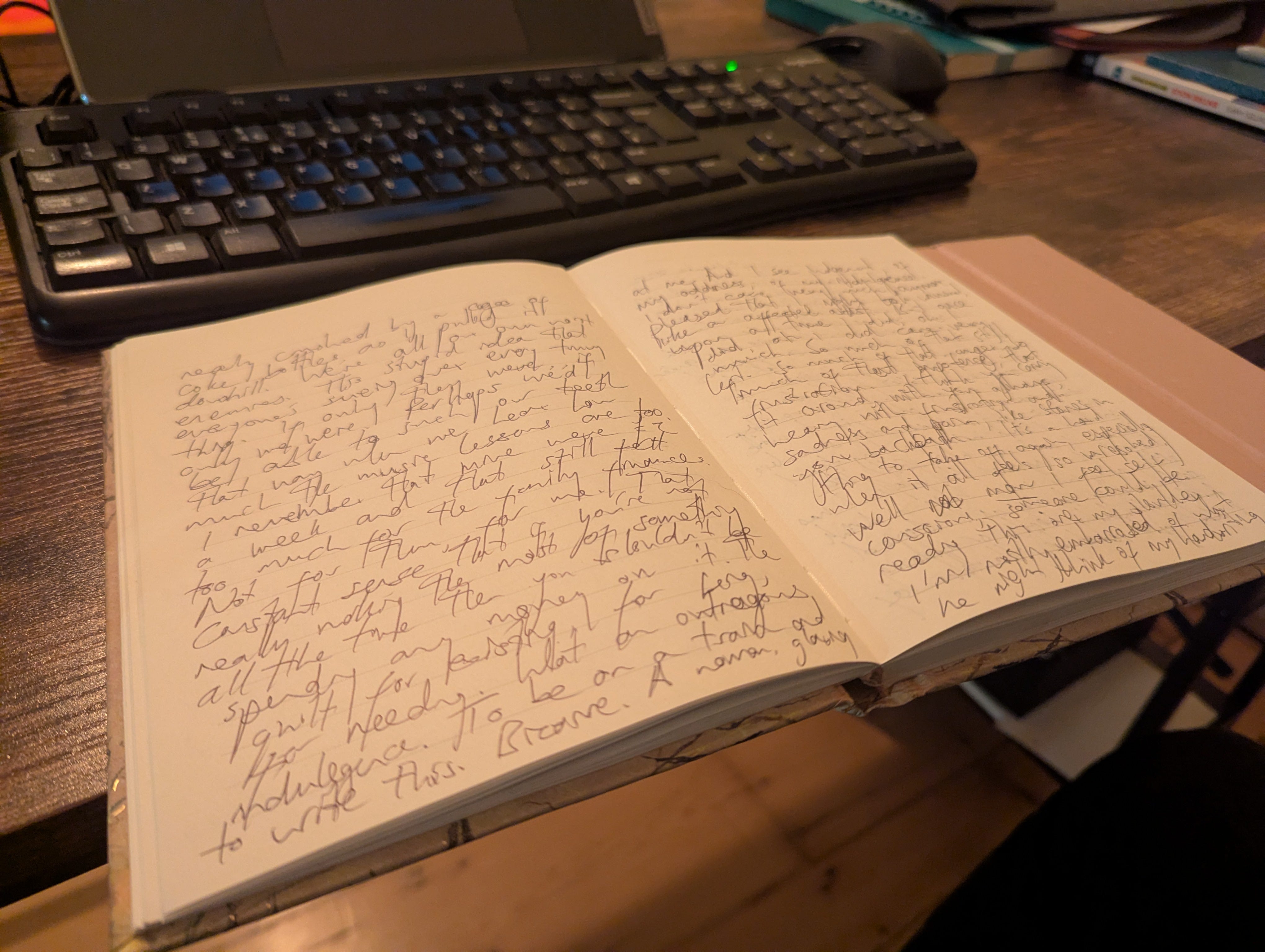
So, aside from all the cost and inconvenience of everything that disappeared with my bag, I was pretty sad to lose it, especially as it felt like my writing had been gradually building momentum over the past few months.
But on the plus side, what a way to really learn that lesson. It was lucky that I’d literally just had my head filled with ideas about the virtue of starting again, or I doubt I’d have remained quite so zen. Even at the time, I could see that the loss gave me a much bigger incentive to lean in, take the positives, and try to use my micro-experience of being forced to start again as a way to interrogate how I actually write, rather than just thinking it was an interesting anecdote and carrying on as normal.
It’s probably a little too early to tell how this will play out in the long run, because between now and then I’ve been thoroughly Decembered, and am only just re-emerging, blinking, into my own projects.
But I did write a new version of the character profile the day after my stuff was nicked, and I’ve been filling a new notebook with Morning Pages. I feel confident that the most important feedback my classmates gave me – the sense of what they thought rather than the details – will stick with me. The things we produce are fragile, and the act of making notes on what my classmates told me they thought about my writing was half the point: I’m sad I don’t still have them, but I don’t feel like they were wasted.
Am I going to throw away the first draft of my novel? No. For now, I’ll keep adding to it – but with a much clearer sense that one day, probably not too long, it really will be time for some serious edits, or perhaps even starting all over again. We will have to see.
But even if I’m not binning the novel yet, what I will do is throw away a gigantic, bloated blog post. This is the post about the final, and the biggest, reason that I put off writing a novel for so long. I’ve been threatening to finish it for months. It’s currently over five thousand words and nowhere near done. I’ve thought about it far too much, for far too long, and it’s become a monster. Time to start all over again.3
When I get to the point where I’m asking what the point is, I tend to be thinking about deeply unhelpful metrics like money and praise and how many readers’ lives I’ve transformed with my incredible insights into human nature. That’s generally when I need to stop and look at a tree for a while or something.
…and presumably this definitely means that my novel is going to be just as good and as successful as Purple Hibiscus, right? Clearly, this is the only natural conclusion to draw here.
It wouldn’t be fair if I didn’t mention that in the course of editing this blog post, I still created two new documents to avoid deleting paragraphs I knew I needed to cut. And that editing remains really bloody hard. Still, what was I saying at the start about gradual and realistic changes?
How very rubbish to lose your bag. But it's all still in you anyway. When I've had to cut, I put those bits in a new document and call it 'to come back to/put elsewhere' or similar. Makes the cutting less painful. And I rarely do use those bits verbatim but the idea or the glimmer of a character might reappear. It's a cliche but nothing is wasted!
I love that your resolutions are a draft 🥳